About a decade ago, I stumbled across a website that would fundamentally change how I viewed user-generated content: marblerun.at.
The site had you taking part in building the world’s largest virtual collective marble run. Every player was given an isolated 10x15 grid plot to place blocks, with the sole requirement being that a rolling marble had to successfully exit the screen toward the finish line. I spent hours on that site absorbed in open-ended marble engineering building intricate pathways and browsing through remarkably creative tracks designed by other players.
That web toy and a handful of open-world building games provided the exact blueprint for what would eventually become marblebuilds.
marblerun.at vs. marblebuilds
While marblerun.at was brilliant for its time, it was inherently limited. It featured a tiny building canvas, a small assortment of components, and a completely passive loop. You built a track, pressed play, and watched gravity do the work. That was about it.
When I started designing marblebuilds, I wanted to create a true spiritual successor to marblerun.at. One that shattered those legacy limitations while preserving the pure, tactile satisfaction of grid alignment.
| Feature Category | marblerun.at (Legacy Toy) | marblebuilds (Modern Sandbox) |
|---|---|---|
| Grid Layout & Canvas Size | Fixed, restricted 10x15 plot | Unlimited, infinite square grid |
| Block Library Size | 12 basic components | 150+ interactive & logic blocks |
| Control System | Entirely linear and passive | Keyboard/mobile Platformer Mode |
| Automation Complexity | None (pure physics momentum) | Visual, block-based logic gates |
| Community Ecosystem | Fragmented, post-Flash legacy | Active Discord & real-time sharing |
Where the legacy site provided basic slopes, loops, and a few physics triggers (like boosters and springs), marblebuilds expands the canvas into a comprehensive engineering sandbox game. It features a massive library of over 150 interactive components, such as portals, pistons, wind blowers, and dynamic spawners; all placeable on a completely unlimited square grid.
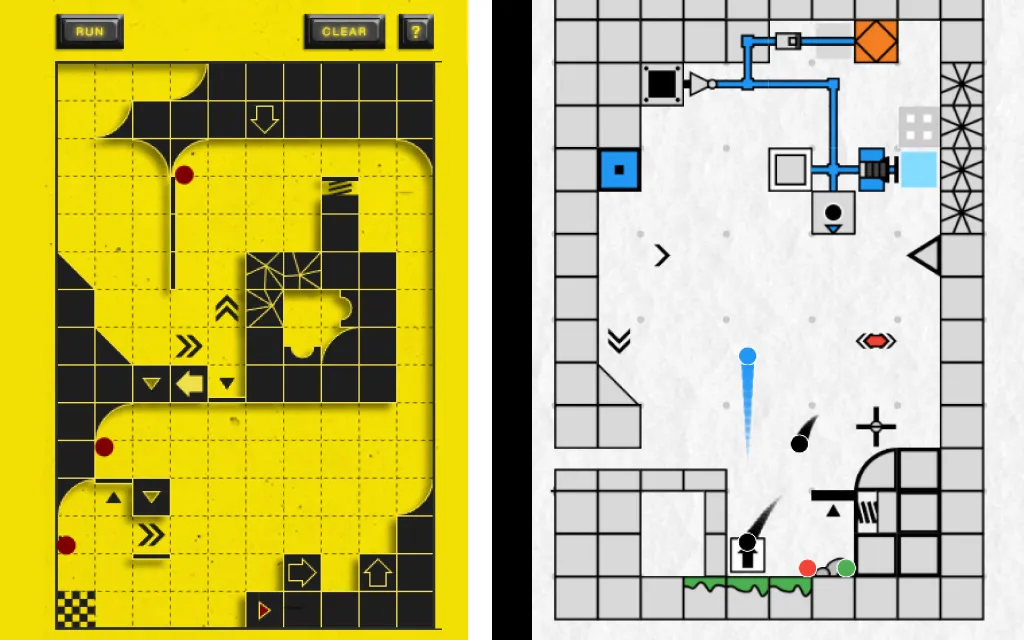
marblerun.at captured the essence of grid building on a small scale, inspiring the seamless snap-to-grid building system behind marblebuilds.
Bridging Art and Tech with Minecraft Redstone
Alongside browser toys, my design philosophy was heavily solidified in Minecraft. For me, building structures and engineering Redstone contraptions were always the two most captivating parts of the game. Minecraft perfectly demonstrated how artistic expression can directly intersect with technical systems.
But as much as I loved those systems, a few things routinely frustrated me.
- The Performance Bottleneck. On a budget laptop, loading up massive 3D worlds took forever, and complex mechanical setups frequently ran into intense compute blockages and frame drops. This isn’t resolvable without installing mods or setting up optimized servers, which are huge barriers for casual players who just want to tinker with Redstone.
- Creative Burnout. The sheer scale of 3D voxel spaces can occasionally feel exhausting when you just want to sit down and rapidly test a mechanical concept.
- The Community Gap. Following the end of the browser-Flash era, the casual online marble run community became highly fragmented, leaving a massive void for players who loved accessible automation and tinkering.
I wanted to capture the magic of structural engineering but compress it into a highly optimized, low-friction environment. This led to the addition of logic circuits to our game.
marblebuilds integrates a Redstone-inspired logic system where players can place wires, logic gates, triggers, and timers onto a fast, precise 2D frame. Just like Redstone, no coding knowledge’s required..
📺 See the System in Action: Check out one of our progress videos to see automated logic integrated into the physics sandbox. (It’s from an old version of the game, to show how integral it was to the game!)
Establishing the Aesthetic
A common question I get from the community is about our visual direction: “Is the art style inspired by Line Rider?”
Surprisingly, I never actually played Line Rider growing up (though I’ve seen the iconic community milestones like Doodlechaos’ Hall of the Mountain King track). Instead, my inspiration comes from a different 2010s web game, Free Rider HD.
I wasn’t a professional illustrator, but I could create clean, effective minimalist art. The style ensures players can easily sightread the track without being distracted by unnecessary visual clutter. It makes it an accessible engineering sandbox for beginners while leaving a completely blank canvas for advanced builders.
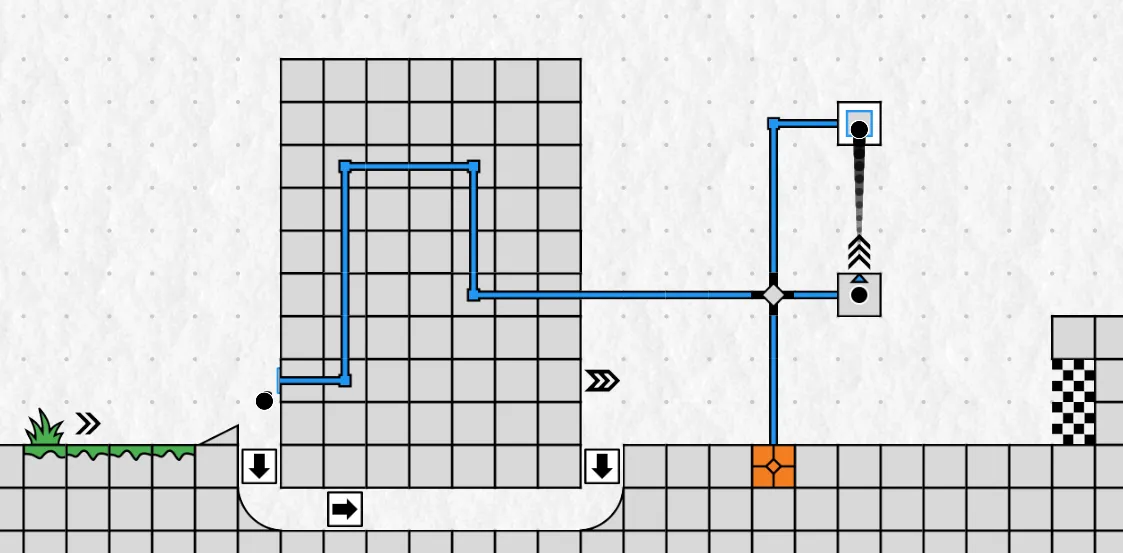
Our minimalist art style is built around clarity, giving players the ability to track visual logic circuitry easily.
Emergent Creativity in marblebuilds
When development on marblebuilds officially started in October 2025, the goal was simple. Make a platform where you can easily build levels with a snap-to-grid building system, and share them with the world.
Throughout our community playtests mid-2026, our players took builds to a whole new level. Thanks to the interaction between physics and block-based logic systems inspired by Minecraft Redstone, the community pivoted entirely into emergent sandbox gameplay.
The reception reminded players of Roblox’s Build a Boat for Treasure experience, where players build everything except an actual boat. In our community, players constructed fully working marble cannons, particle accelerators, animated music stages, and intricate arcade minigames like Pinball, Plinko, and Connect 4.
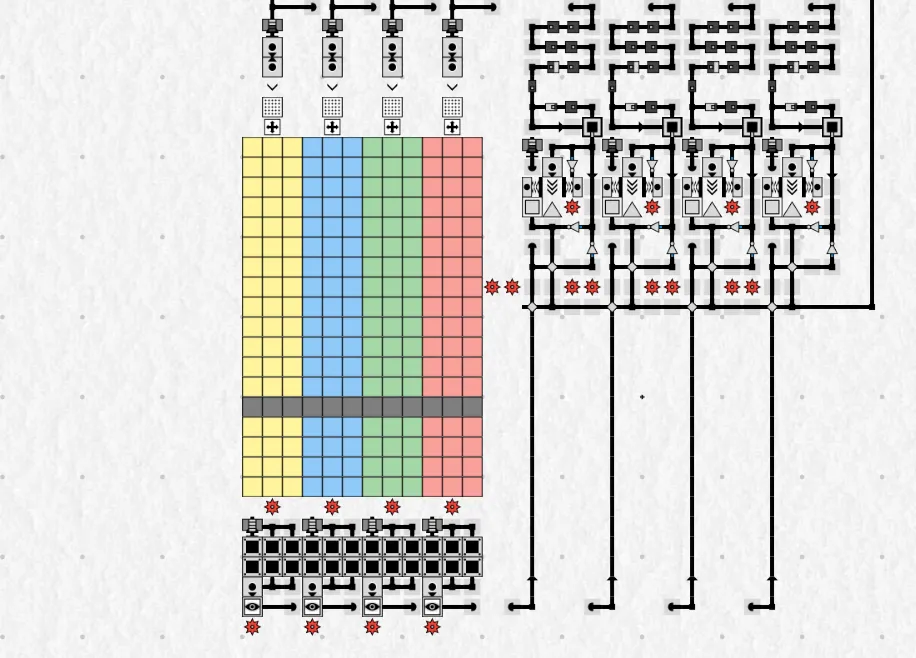
Sandbox creativity driven by physics and logic. Community members use marblebuilds to design everything from linear tracks to fully interactive minigames.
That doesn’t mean classic marble runs have vanished, either. Early creators like GHY masterfully utilized our colored track components to forge breathtaking, sweeping marble runs that are genuine works of digital art. Watching players weave digital logic circuits together with rigid-body mechanics has been the most refreshing creative evolution I’ve witnessed since the golden days of Minecraft engineering.
Looking Ahead to the Future of Building
marblebuilds is designed to be easy to learn, difficult to master, providing a STEM-friendly physics sandbox where anyone can experience the thrill of invention without an engineering degree.
The project is evolving every single day thanks to player feedback. If you want to jump in, test your logical skills, and help us shape the next generation of contraption building, we would love to have you along for the ride.
- Play Instantly: Try our fast grid system today on the Free marblebuilds Web Demo.
- Support the Project: Wishlist the game on our Official Steam Page.
- Share Your Builds: Join our creative hub on the Official Grizbuilds Discord Server to swap level codes and logic circuit designs!
Related Articles
- Marblebuilds vs Algodoo: Which 2D Physics Sandbox Is Right for You?
- 2D Redstone: Why Minecraft Engineers Need to Try marblebuilds
- The Geometry Dash Crossover: Why GD Level Creators Are Flocking to marblebuilds
- How Logic Circuits Work in Marble Physics Games
- Building Your First Marble Contraption: A Beginner’s Guide
- The 150+ Block Library Explained: What Makes marblebuilds Different